
Every spring, this season arrives with baskets of candy, brightly colored eggs, and the familiar image of a cheerful bunny. Families gather, children hunt for hidden treats, and store shelves fill with pastel decorations. For many people, these traditions have become the defining images of the season.
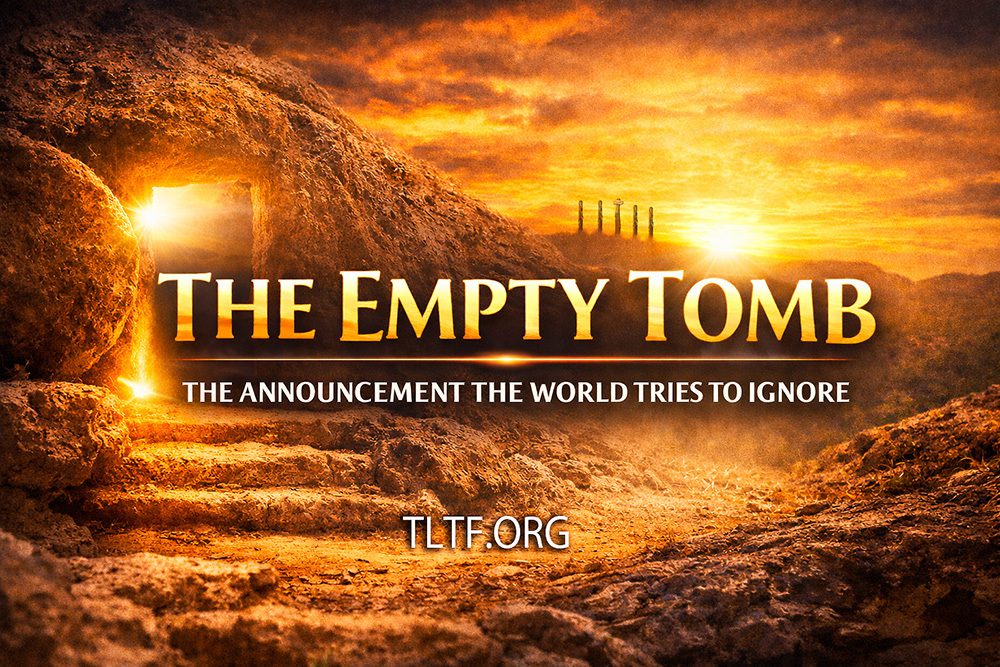
But those images have little to do with the event that changed the course of human history. The true center of this time of year is not found in baskets or decorations, but in an empty tomb.
Nearly two thousand years ago, Jesus of Nazareth was executed by Roman authorities and laid in a sealed tomb. Three days later, that tomb stood empty. That single event changed the course of history and became the foundation of the Christian faith.
The resurrection of Jesus Christ is not a legend or a symbolic tradition. It is a historical event witnessed by many and recorded in Scripture. Everything about Christianity stands or falls on that empty tomb.
The resurrection of Jesus did not occur in isolation. It took place during the Passover season—the very time when Scripture remembers God’s great deliverance.
Modern culture, however, often buries that reality beneath distraction. Behind the systems of this world stands an enemy of God who has long worked to obscure the truth. The resurrection of Jesus Christ was the decisive act that shattered the power of death—the very weapon the devil has wielded since the beginning. Scripture declares that through his death and resurrection Jesus destroyed the one who held the power of death, that is, the devil (Hebrews 2:14).
That victory was a crushing blow to the adversary, and ever since, his mission has been to cloud the truth and divert attention from what actually happened. Traditions like decorated eggs and rabbits have become some of the most visible features of the celebration. While they may appear harmless, they quietly shift attention away from the event that changed everything.
When Jesus died, he was truly dead. Roman soldiers trained in execution confirmed it. His side was pierced. His body was wrapped in linen and laid in a tomb sealed with a massive stone. Guards were posted to ensure that no one could tamper with the grave. The tomb was sealed, the guards were posted, and the body was buried.
Yet on the third day, the tomb stood empty.
Jesus appeared alive—not just to one grieving follower, but to many witnesses. Individuals saw him. Groups saw him. Even skeptics like Thomas, who demanded physical proof, encountered the risen Lord. At one point, more than five hundred people saw him alive at the same time (1 Corinthians 15:6). The resurrection was not a private vision or a mystical experience. It was public, witnessed, and boldly proclaimed.
The empty tomb was God’s declaration that His Son had been vindicated, his mission accomplished, and death itself conquered. It also validates everything Jesus taught. If he had remained in the grave, his claims would have collapsed, and his followers would have been left clinging to a false hope. If God raised him from the dead, then heaven has spoken decisively. As Paul wrote, “If Christ has not been raised, our preaching is useless and so is your faith” (1 Corinthians 15:14).
The empty tomb confirms that Jesus truly is the one God sent, and it forces us to think honestly about death itself. Our culture often softens death with phrases like “passed on” or “gone to a better place,” but Scripture speaks more plainly. Death is an enemy. It is the end of life, not a doorway into another conscious realm.
When people die, they are truly dead, awaiting the resurrection God has promised. That is why Jesus described death as “sleep.”
“Our friend Lazarus has fallen asleep; but I am going there to wake him up.” (John 11:11)
Sleep is a fitting picture because it is temporary. The dead are not alive somewhere else; they await the moment when Jesus awakens them through resurrection.
Scripture also shows that resurrection unfolds in stages within God’s plan. The first resurrection connected with the hope of believers today occurs when Jesus appears and gathers the Church to himself.
“For the Lord himself will come down from heaven… and the dead in Christ will rise first.” (1 Thessalonians 4:16)
Believers who have died will be raised, and those still alive will be gathered together with them to meet the Lord. Other groups will be raised later in God’s unfolding plan. No one will escape the certainty of God’s resurrection. In the end, every person who has ever lived will stand again because of the resurrection made certain by Jesus Christ. Those who belong to him will inherit everlasting life in the age to come, but those who rejected him will face final judgment and the second death.
The empty tomb reveals the solution to death itself. Jesus is called the “first-fruits of those who have fallen asleep” (1 Corinthians 15:20). In Israel’s harvest pattern, the first sheaf offered to God was the guarantee that the full harvest would follow. His resurrection was not an isolated miracle; it was the beginning of what God has promised for all who belong to him. This reality is therefore not only about what happened to Jesus; it is about what will one day happen to all who trust in him.
Even the timing of the resurrection was deliberate. Jesus rose on the day after the Sabbath, aligning with the Feast of First-fruits described in Leviticus 23:10–11. Just as he died at Passover as the true Lamb, he rose on First-fruits with remarkable prophetic precision. What appeared to be a tragedy unfolding outside Jerusalem was, in fact, the fulfillment of a plan God had set in motion long before the stone was rolled away.
Because of that empty tomb, the future of humanity changed forever. It reshapes the present as well. Scripture declares that just as Christ was raised from the dead, we too may walk in newness of life (Romans 6:4). The resurrection is not only a promise for the future; it gives courage in suffering, freedom from the fear of death, and strength to live faithfully now.
The empty tomb still declares the same message to the world today: death does not have the final word, sin does not have the final word, and darkness does not have the final word. In the resurrection of Jesus Christ, God has spoken decisively—life will ultimately triumph over the grave.
The empty tomb demands a response. If Jesus truly rose from the dead, then no life can remain unchanged. Neutrality is not an option here. The resurrection confronts every person with a choice that cannot be avoided.
The risen Christ calls for faith, allegiance, and transformation. He calls us to turn from the paths that lead to death and to entrust our lives to the one whom God raised from the grave. Scripture makes it plain that life is found in him, and those who believe in him receive the promise of the age to come.
“If you declare with your mouth, ‘Jesus is Lord,’ and believe in your heart that God raised him from the dead, you will be saved.” (Romans 10:9)
This is not merely a statement to agree with; it is a truth that demands a decision. Each person must decide whether to ignore the announcement of the empty tomb or embrace the life that God now offers through His risen Son.
The resurrection of Jesus is not just an event to remember once a year; it is a summons. It calls us to believe, to follow, and to live in the light of the life God has made available through Jesus Christ.
For many years, the resurrection has been more than a doctrine for me to defend; it has become an anchor in life’s darkest moments. When circumstances feel uncertain and the future unclear, the empty tomb stands as an unshakable reminder that God keeps His promises.
Because Jesus lives, despair does not have the final word. The empty tomb means death no longer intimidates us, our faith is not wishful thinking, and our labor in the Lord is never wasted (1 Corinthians 15:58). It means we live with purpose, carrying the hope of resurrection into a dying world. While the world may focus on eggs and bunnies, the truth remains unchanged: the tomb is empty, death has been defeated, and Jesus lives. Because he lives, life has conquered death, and God’s promise of resurrection stands unshaken.
In Resurrection Hope,

Comments
Wonderfully explained!
I’ve recently been watching YouTube documentaries about the End Times, which we seem to be approaching quickly.
I have a funny (or at least interesting) story to tell.
On 8/9/1981, my friends and I went to a go-go bar (strip club)—my very first time at one. I was talking with a dancer named Tara between her sets, and it seemed like we might be going home together after her last set. Then, in the men’s room, a guy told me that Tara was a transsexual.
Well, I ran out of there and went down the street to a local pub, where I immediately met an attractive woman. This time, I made sure she didn’t have an Adam’s apple! She ended up witnessing to me about God—and that became the most important moment of my life, coming right after one of the most embarrassing.
Thanks, Franco… terrific reminder, which is always timely, no matter the season. Can’t wait to have you and yours (and the other amigos) here in Maryland. God bless you!
Frank
Beautiful Franco. Thank you!
🎶 Because he lives I can face tomorrow
Because he lives all fear is gone
Because I know who holds the future
Now life is worth the living just because he lives🎶😇🙏🏻
God’s blessings to you all at TLTF
In Resurrection Hope ❤️
Patricia Friary