
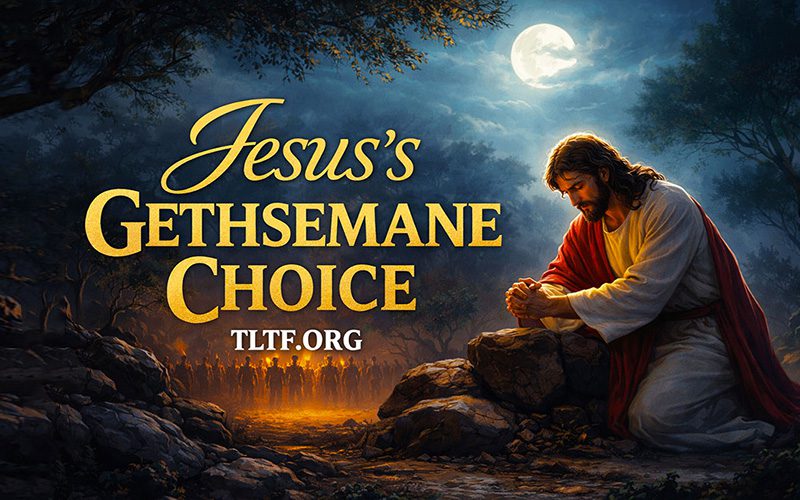

Jesus of Nazareth was no ordinary human. He was extraordinary in every way, and he demonstrated the depth of his godly character throughout his life. This section of Hebrews is just one of many biblical testimonies to the depth of Jesus’ commitment to loving God and people. The author of Hebrews, after providing multiple examples of believers who lived and died in faithfulness to God, culminates with this admonition for us:
“Therefore, since we are surrounded by so great a cloud of witnesses, let us lay aside every weight and the sin that so easily entangles us, and let us run with endurance the race set before us, fixing our eyes on Jesus, the leader and finisher of our trust, who, for the joy set before him, endured the cross, thinking nothing of the shame, and has sat down at the right hand of the throne of God. Yes, consider him who endured such opposition from sinners against himself, so that you do not grow weary and become exhausted in your souls.” (Hebrews 12:1–3)
Jesus, unlike any of those saints listed in Hebrews chapter 11, was in no sense deserving of the accusations, arrest, torture, and death that were inflicted upon him. He was a sinless man. Yet he walked into Jerusalem with full knowledge of the evil that awaited him, and he did it alone. He had repeatedly informed his disciples of what was ahead, but they simply could not grasp or accept it. So Jesus, a sinless soul, obediently stepped forward and allowed all the evil of the world to fall upon him—evil that in no way could rightly be laid at his feet. Yet he accepted it without offering a single word of objection.
“As a lamb that is led to the slaughter and as a sheep that before its shearers is silent, so he did not open his mouth.” (Isaiah 53:7b)
How could anyone endure such things, knowing they were completely unjust? Hebrews tells us it was because of the joy set before him. It was joy that sustained Jesus through every step to the cross. Not just any joy, but the joy of knowing he was carrying out God’s plan—a plan that would forever provide the solution to sin and death. His choice to obey and his commitment to endure serve as the ultimate example for all believers.
In Gethsemane, Jesus prayed earnestly three times, asking the Father if there was any way for the coming torture and death to be taken from him. Scripture does not directly record God’s answer to that prayer. However, in John 11:41–42, Jesus said he knew the Father always heard him. It is hard to imagine that his prayer in Gethsemane was either unheard or unanswered.
Later in Gethsemane, he was arrested, and Peter attempted to defend him by cutting off Malchus’ ear. Jesus healed Malchus and then said:
“Put your sword back in its place, for all who take the sword will perish by the sword. Do you think that I cannot call on my Father, and he will at once put at my disposal more than twelve legions of angels? But how then would the Scriptures be fulfilled that say it must happen this way?” (Matthew 26:52–54)
In these words, it appears Jesus revealed the Father’s response to his earlier prayer. His statement about twelve legions of angels is not a quotation of prophecy regarding the Messiah. Rather, it seems to reflect a real option that was set before him—one he ultimately declined.
Jesus consistently taught that his words were not his own (John 12:47–50). He spoke what the Father revealed to him, whether through Scripture or direct revelation. Therefore, when he spoke about the angels at his disposal, it was not a vague generalization but a disclosure of what the Father had made known to him during his prayer in the garden.
Jesus understood from Scripture what was to happen to the Messiah, yet he still asked the Father if there was another way. He knew from accounts like Abraham and Isaac that God could, at times, alter the course while still accomplishing His purpose. So Jesus asked. It seems that in response, God showed him that he could walk away—that he could call upon heavenly forces for immediate deliverance. Yet Jesus also knew that doing so would not fulfill the plan of redemption that had been unfolding since Adam first sinned.
Jesus had a choice: call for the heavenly host to rescue him, or remain on the path to the cross. He chose the cross.
What love Jesus demonstrated. When given the opportunity to display his power and call upon angels instantly, he instead chose the harder path. He endured the cross, despising its shame and suffering, because he loved the Father, he loved people, and he saw that through his obedience, all of creation could be redeemed. What a man. What an extraordinary man the Son of God was—and is.
Jesus, this man from Galilee, is no ordinary man. He is our Savior—and not ours alone. He is the final payment for all, because he chose the cross.
My prayer for all of us as we celebrate this resurrection season is that we follow Jesus’ example. May we look forward to the joy set before us—the hope of everlasting life—and allow that joy to give us the endurance we need to remain faithful to the end.
Yours in Christ,

Comments
… And yet the majority of Christians believe God forsake Jesus on the cross. Thank God for the Word; Rightly Divided!!!