
Every December, Christians around the world celebrate the birth of Jesus Christ, and December 25 has become so closely associated with his birth that many people naturally assume the date comes from the Bible. It does not. Scripture never states that Jesus was born on December 25, nor does it give his birth date in a single verse. If we want to investigate when Jesus was born, we must bring together a number of biblical details and then examine how they fit with what can be reconstructed from history and astronomy.
When those lines of evidence are considered together, we believe they point strongly toward the early fall of 3 B.C. More specifically, September 11, 3 B.C., corresponding to Tishri 1 on the Hebrew calendar, provides the most compelling specific date within that reconstruction. That conclusion, however, requires an important qualification from the beginning: the Bible does not say, “Jesus was born on September 11, 3 B.C.” Some parts of the argument are stated directly in Scripture, while others are deductions based on biblical chronology, historical records, and astronomical calculations. The strength of the case therefore does not depend on making any single piece of evidence prove more than it can, but on seeing how the various lines of evidence fit together.
The Chronology Begins with Zechariah
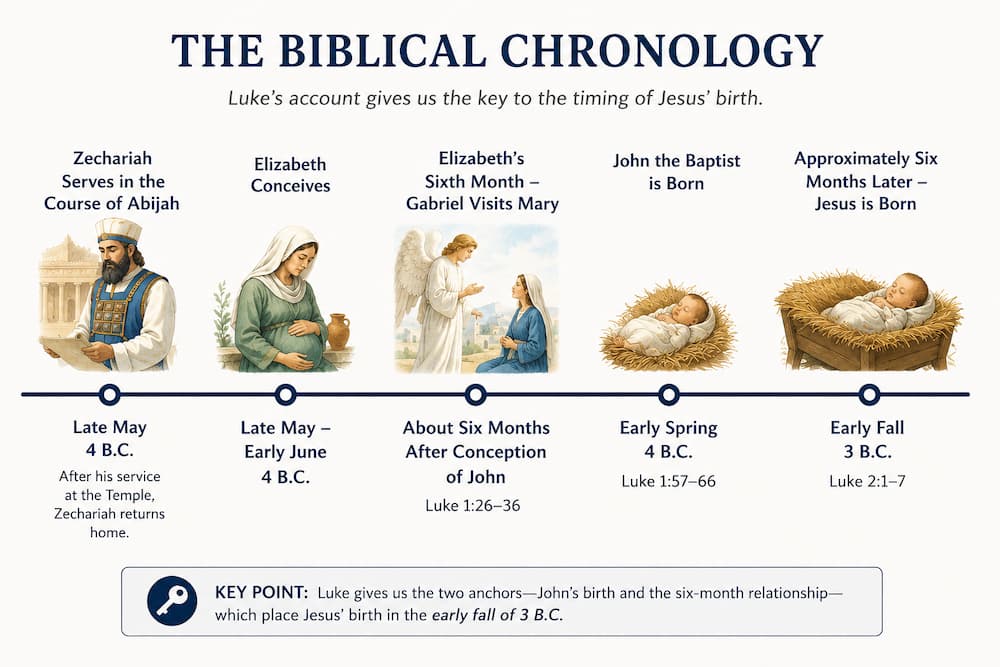
Luke does something significant when he begins his record of the events surrounding Jesus’ birth. He does not begin with Mary or Joseph, but with Zechariah, the father of John the Baptist: “In the time of Herod king of Judea there was a priest named Zechariah, who belonged to the priestly division of Abijah” (Luke 1:5). That reference to the division of Abijah gives us an important chronological clue.
First Chronicles 24 explains that the descendants of Aaron were divided into twenty-four priestly courses that served at the Temple according to an established rotation, with Abijah designated as the eighth course (1 Chron. 24:10). One reconstruction of that rotation places Zechariah’s period of service in late May of 4 B.C. Luke tells us that after completing his service at the Temple, Zechariah returned home, and Elizabeth subsequently became pregnant (Luke 1:23–24).
Luke then gives us another explicit chronological marker. When Gabriel appeared to Mary, Elizabeth was already in the sixth month of her pregnancy: “In the sixth month of Elizabeth’s pregnancy, God sent the angel Gabriel to Nazareth”(Luke 1:26). Gabriel also told Mary, “Even Elizabeth your relative is going to have a child in her old age, and she who was said to be unable to conceive is in her sixth month” (Luke 1:36). John the Baptist was therefore approximately six months older than Jesus.
Following the proposed priestly-course chronology forward places Elizabeth’s conception around late May or early June of 4 B.C., Mary’s conception approximately six months later, and the birth of Jesus approximately nine months after that—in September of 3 B.C. The six-month relationship between John and Jesus comes directly from Luke, while the placement of Zechariah’s particular service on our modern calendar requires a reconstruction of the ancient priestly schedule. That distinction is important: Scripture provides the chronological framework, while historical reconstruction supplies the proposed calendar dates.
The Shepherds Fit an Early-Fall Birth
Luke records that on the night Jesus was born, “there were shepherds living out in the fields nearby, keeping watch over their flocks at night” (Luke 2:8). This detail has often been used to argue against a December birth, and there is good reason to take it seriously. The shepherds were not simply taking their sheep outside during the daytime; they were remaining with their flocks in the fields through the night.
In the agricultural practices of the region, shepherds could keep their animals in cultivated fields during the late summer and early fall, where the sheep fed on what remained after harvest while fertilizing the ground. That fits an autumn setting naturally. At the same time, Luke 2:8 should not be made to carry more chronological weight than it can. Judean winters vary, and the presence of shepherds outdoors cannot by itself eliminate every possible winter date. The shepherds therefore provide supporting evidence for an early-fall birth rather than proof of a particular day.
Jesus Was Born During the Reign of Herod
Matthew supplies another fixed historical point: “After Jesus was born in Bethlehem in Judea, during the time of King Herod…” (Matt. 2:1). Any proposed chronology must therefore place Jesus’ birth before the death of Herod the Great.
The historical discussion becomes more complicated when we try to determine when Herod died. The first-century Jewish historian Josephus tells us that shortly before Herod’s death there was an eclipse of the moon and that Herod died before the Passover that followed. The question is which lunar eclipse Josephus was describing. The chronology most commonly accepted in modern scholarship identifies it with the partial lunar eclipse of March 13, 4 B.C. If that identification is correct, Jesus necessarily had to be born before that time, which is why many traditional chronologies place his birth somewhere between 6 and 4 B.C.
Another substantial reconstruction, however, identifies Josephus’s eclipse with the lunar eclipse of January 9/10, 1 B.C.Researchers who support this chronology argue that it allows considerably more time for the numerous events Josephus describes between the eclipse and the following Passover, including Herod’s final illness, political and judicial events, his death and funeral, the succession of Archelaus, and the disturbances that occurred before Passover. Within that reconstruction, Herod remained alive well after a September 3 B.C. birth of Jesus.
We believe the 1 B.C. chronology provides a persuasive and coherent explanation of the historical evidence, but it should not be presented as an uncontested fact. The identification of Josephus’s eclipse remains a debated historical question, and acknowledging that disagreement does not weaken the case for September 3 B.C.
Herod, the Magi, and the Two-Year Period
Matthew gives another chronological clue when the Magi arrive in Jerusalem and ask, “Where is the one who has been born king of the Jews? We saw his star when it rose and have come to worship him” (Matt. 2:2). Herod then questions them carefully: “Then Herod called the Magi secretly and found out from them the exact time the star had appeared”(Matt. 2:7).
After the Magi found Jesus and returned home without reporting back to Herod, the king ordered the killing of the male children in Bethlehem: “He gave orders to kill all the boys in Bethlehem and its vicinity who were two years old and under, in accordance with the time he had learned from the Magi” (Matt. 2:16). This is important chronological evidence, but it should be interpreted carefully. Herod’s two-year limit does not mean that Jesus was exactly two years old, nor does Matthew explicitly say that the astronomical sign first appeared at the precise moment Jesus was born. Herod was attempting to eliminate a perceived rival to his throne and would have had every reason to make his order broad enough to ensure that the child was included.
What Matthew does establish is that Herod regarded the timing of the astronomical sign reported by the Magi as relevant to determining the age of the child. That makes the astronomical activity surrounding 3 and 2 B.C. particularly significant.
What Was the “Star” of the Magi?
Many traditional Christmas scenes portray a brilliant stationary star hovering directly over Bethlehem, but Matthew does not actually describe such a scene. The word translated “star” did not necessarily refer only to what modern astronomy calls a fixed star; planets and other visible heavenly bodies could also be described with star terminology.
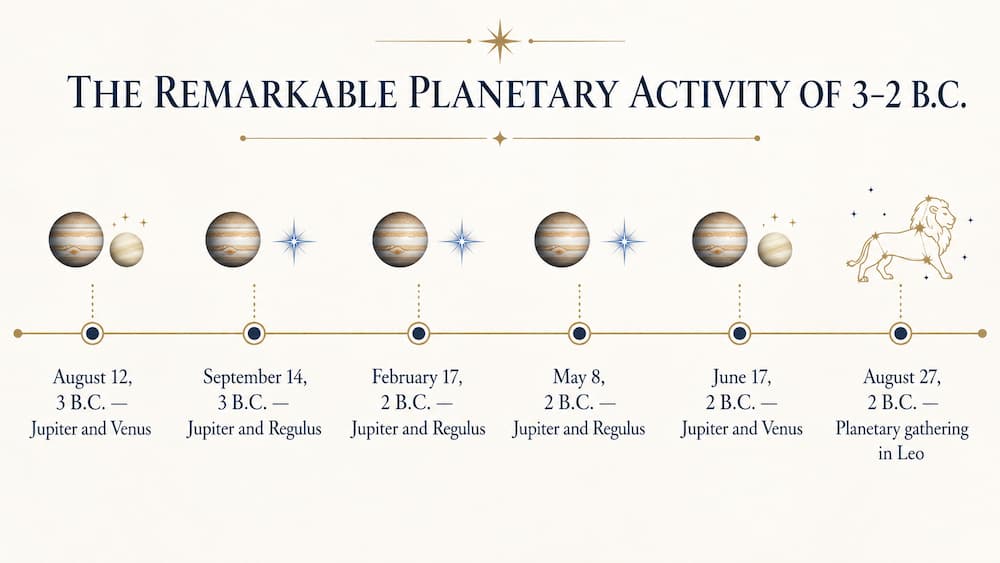
During 3 and 2 B.C., an extraordinary sequence of planetary events occurred. In August of 3 B.C., Jupiter and Venus came into a notable conjunction. Jupiter subsequently moved into conjunction with Regulus, the principal star in the constellation Leo, and because of Jupiter’s apparent retrograde motion, it came into conjunction with Regulus three times over the following months. Additional striking events followed, including an exceptionally close conjunction of Jupiter and Venus in June of 2 B.C. and a notable gathering of planets in Leo later that summer.
The astronomical events themselves can be calculated; the more difficult question is how ancient observers understood them. Jupiter was widely associated with kingship, Regulus was regarded as a royal star, and Leo carried royal associations. Such a sequence would have been extraordinary to people trained to observe and interpret movements in the heavens, providing a plausible historical background for the Magi’s conviction that they had witnessed a sign associated with the birth of a king.
The “Great Sign” of Revelation 12
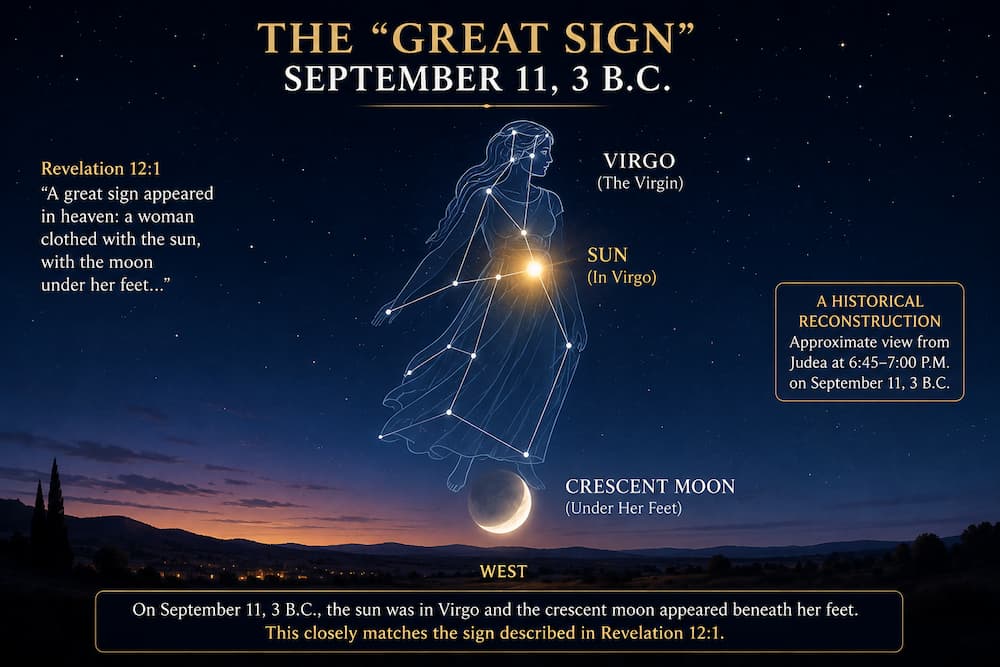
The most specific astronomical component of the September 11 chronology comes from Revelation 12: “A great sign appeared in heaven: a woman clothed with the sun, with the moon under her feet…” (Rev. 12:1). The woman is pregnant and gives birth to “a son, a male child, who ‘will rule all the nations with an iron scepter’” (Rev. 12:5). The language is unmistakably messianic, drawing directly upon Psalm 2 and pointing to Jesus Christ.
Because Revelation is highly symbolic literature, caution is necessary. We should not automatically assume that every element of the vision must correspond to a literal astronomical event. Nevertheless, John specifically describes a “great sign … in heaven” involving a woman, the sun, the moon, and the birth of the Messiah. That raises a legitimate question: could the imagery also correspond to something visible in the heavens around the time Jesus was born?
When the sky over Judea is reconstructed for 3 B.C., the correspondence becomes remarkable. During late August and early September, the sun was positioned in the region of the constellation Virgo—the Virgin. On September 11, 3 B.C., the moon appeared beneath the feet of Virgo while the sun was within the constellation, closely resembling the central imagery of Revelation 12:1.
Within the September 3 B.C. chronology, that configuration becomes one of the most significant pieces of astronomical evidence pointing toward a particular day.
Why September 11?
The Revelation 12 configuration narrows the proposed chronology from a season to a particular day. Astronomical calculations indicate that during 3 B.C. the sun occupied the appropriate region of Virgo for only a limited period, and the additional requirement that the moon be beneath the woman’s feet narrows the configuration further. On September 11, the required relationship between Virgo, the sun, and the moon occurred.
That date becomes even more significant when compared with the ancient Hebrew calendar. The evening beginning September 11, 3 B.C., has been calculated to correspond with Tishri 1, the first day of the seventh month. According to biblical reckoning, a new day began in the evening, and Tishri 1 was the Day of Trumpets: “On the first day of the seventh month you are to have a day of sabbath rest, a sacred assembly commemorated with trumpet blasts” (Lev. 23:24).
We should not reverse the argument and say that Jesus must have been born on Tishri 1 simply because the symbolism seems appropriate, since Scripture never states that the Messiah had to be born on the Day of Trumpets. But if the chronological and astronomical evidence independently brings us to Tishri 1, the biblical significance of the date provides meaningful corroboration. The possibility that the promised King entered the world on a day marked throughout Israel by the sounding of trumpets is certainly striking.
Can We Determine the Time of Night?
Detailed astronomical calculations narrow the proposed Revelation 12 configuration still further. On September 11, 3 B.C., sunset in Judea has been calculated at approximately 6:18 P.M., with the moon setting at approximately 7:39 P.M.This provides an astronomical window of about eighty-one minutes during which the sun and moon occupied the relationship described in the proposed Revelation 12 reconstruction.
This has led some researchers to conclude that Jesus was born sometime between approximately 6:18 and 7:39 P.M. That is an intriguing possibility, particularly because Luke tells us that the shepherds were watching their flocks “at night” when the angel announced that the Messiah had been born (Luke 2:8–11). Even so, we should continue to distinguish between what Scripture explicitly says and what the astronomical reconstruction suggests. The Bible tells us that Jesus was born and that the announcement to the shepherds occurred at night, but it does not give us a clock time.
If Revelation 12:1 is describing the literal configuration of the heavens at the moment of Jesus’ birth, then the eighty-one-minute astronomical window becomes extremely significant. If Revelation 12 is using celestial imagery more broadly, the astronomy cannot by itself establish the precise time of his birth. The astronomical window therefore strengthens the September 11 reconstruction without requiring us to claim that Scripture explicitly gives the hour.
A Note About Stellarium and Other Astronomy Programs
Some readers who attempt to reproduce these astronomical calculations using programs such as Stellarium may initially find that the dates or constellation positions appear different. One important reason is the way astronomy software numbers ancient years. Our historical calendar has no year zero; it moves directly from 1 B.C. to A.D. 1. Astronomical year numbering, however, commonly includes a year zero.
Therefore, 1 B.C. corresponds to astronomical year 0, 2 B.C. to year −1, and 3 B.C. to year −2. To investigate September 11, 3 B.C. in software that uses astronomical year numbering, the year must therefore be entered as −2.
Astronomy programs may also use different constellation artwork or modern constellation boundaries, which are not identical to the way ancient observers pictured the constellations. For that reason, the important question is not whether a modern drawing of Virgo looks exactly like an expected illustration, but whether the calculated positions of Virgo, the sun, and the moon correspond to the proposed configuration at that time.
What Does the Evidence Actually Establish?
It is useful to separate the evidence into levels of certainty. Scripture explicitly tells us that Jesus was born in Bethlehem during the reign of Herod, that John the Baptist was approximately six months older than Jesus, that shepherds were in the fields at night when Jesus was born, that the Magi observed an astronomical sign associated with the king of the Jews, and that Herod questioned them about when that sign first appeared.
Historical and chronological reconstruction suggests that Zechariah’s priestly service occurred in late spring of 4 B.C., that Herod may have died in 1 B.C. rather than 4 B.C., and that these events provide a coherent framework for the birth of Jesus in September of 3 B.C. Astronomical calculations establish that remarkable planetary events occurred during 3 and 2 B.C. and that the sun and moon occupied the proposed relationship to Virgo on September 11, 3 B.C.
The final step is interpretive: Revelation 12 is connected with that astronomical configuration as evidence concerning the particular day of Jesus’ birth. Keeping these distinctions clear does not weaken the case; it makes the argument more responsible and allows readers to evaluate each part of the evidence on its own merits.
So When Was Jesus Born?
When the biblical, historical, chronological, and astronomical evidence is brought together, we believe the strongest reconstruction places the birth of Jesus Christ in the early fall of 3 B.C. More specifically, September 11, 3 B.C.—Tishri 1 on the Hebrew calendar—is the most compelling specific date within that reconstruction.
The case is cumulative. Luke’s chronology of Zechariah, Elizabeth, John, and Mary points toward the latter part of the year. The shepherds remaining with their flocks through the night fits an autumn setting. The historical reconstruction placing Herod’s death in 1 B.C. provides ample room for a 3 B.C. birth. Matthew makes the timing of the astronomical sign seen by the Magi relevant to the chronology. An extraordinary sequence of planetary events occurred in 3 and 2 B.C., and the configuration of Virgo, the sun, and the moon on September 11, 3 B.C. corresponds strikingly with the imagery of Revelation 12 and falls on Tishri 1, the Day of Trumpets.
No single piece of evidence should be stretched beyond what it can establish, but taken together, these lines of evidence form a remarkably coherent picture.
Why Does the Date Matter?
Knowing the date of Jesus’ birth is not necessary for salvation, nor does Scripture command Christians to observe his birthday. What matters far more is the one who was born. The angel did not announce a date to the shepherds; he announced a person: “Today in the town of David a Savior has been born to you; he is the Messiah, the Lord” (Luke 2:11).
The purpose of investigating these details is therefore not to replace one religious tradition with another, but to return as carefully as possible to the biblical record and allow truth rather than assumption or tradition to shape our understanding. Some may examine the evidence and remain unconvinced that September 11 can be established as the precise date, while others may find the convergence of the evidence compelling. Either way, our confidence in Jesus Christ does not rest upon reconstructing a date two thousand years later; it rests upon what God has revealed about His Son.
The promised seed came. The Son of God was born, grew to manhood, faithfully carried out the will of his Father, gave his life for us, and was raised from the dead and exalted by God as Lord. That is the truth worth celebrating every day.
For Further Study
For additional study concerning the birth of Jesus Christ, its chronology, and the biblical record surrounding these events, we recommend the following resources from The Living Truth Fellowship:
Unwrapping the Mystery: The Truth of Christ’s Birth
A broader examination of the biblical record surrounding Jesus’ birth and some of the traditions that have become associated with it.
Was Jesus Born on December 25 or September 11?
A focused treatment of the evidence for an early-September birth and the September 11, 3 B.C. chronology.
The Birth of Christ
Additional biblical teaching concerning the circumstances and significance of the birth of Jesus Christ.
For readers who want to examine the detailed historical and astronomical research underlying the September 3 B.C. chronology, two important research works are Jesus Christ Our Promised Seed by Victor Paul Wierwille and The Star That Astonished the World by Ernest L. Martin.
Comments
Could you please clarify in this blog where the astronomical evidence is sourced from? I have searched on Stellarium and do find any alignment of the Sun in Virgo, and the moon at the feet of Virgo (nor the 12 stars at her crown) for the Sept, 11th, 3BC date. Much less for the time frame given in this blog.
Veronica, thank you for your question. The astronomical case presented in this article comes primarily from the research assembled in Jesus Christ Our Promised Seed by Victor Paul Wierwille and The Star That Astonished the World by Ernest L. Martin.
An important distinction may help when evaluating the evidence. The astronomical calculations themselves establish that specific celestial events occurred during 3–2 B.C., including the Jupiter-Regulus and Jupiter-Venus conjunctions, and that on September 11, 3 B.C., the sun and moon occupied the proposed relationship to the constellation Virgo. The additional step of connecting that configuration with the imagery of Revelation 12:1 is interpretive. Because Revelation is symbolic literature, we do not believe every feature of the vision—including the crown of twelve stars—must necessarily correspond one-for-one with a literal astronomical object in order for the imagery to have an astronomical correspondence.
Jesus Christ Our Promised Seed examines this proposed configuration in its chapters dealing with the day and time of Jesus’ birth, the significance of Tishri 1, and astronomy and the birth of Christ. The reconstruction identifies September 11, 3 B.C., as the day on which the sun was positioned within Virgo and the crescent moon appeared beneath her feet, with the relevant configuration visible from Judea between approximately 6:18 and 7:39 P.M. The Star That Astonished the World develops the broader historical and astronomical chronology surrounding the same period, including the activity of Jupiter, Regulus, Venus, the Magi, and the chronology of Herod.
Regarding Stellarium specifically, there is an important calendrical issue that can easily cause confusion. Stellarium uses astronomical year numbering, which includes a year zero, while the traditional B.C./A.D. calendar does not. Therefore, 1 B.C. is astronomical year 0, 2 B.C. is year −1, and 3 B.C. must be entered as year −2. Constellation artwork can also vary between programs, so the important comparison is the calculated position of Virgo, the sun, and the moon rather than whether a modern drawing of Virgo visually matches an ancient figure exactly.
The historical chronology is also a reconstruction rather than an uncontested fact. Josephus records a lunar eclipse shortly before Herod’s death, and one significant reconstruction identifies that eclipse with January 9/10, 1 B.C. rather than the commonly proposed March 13, 4 B.C. That allows a September 3 B.C. birth to fit naturally within Herod’s lifetime. We believe this chronology provides a persuasive explanation of the evidence, while recognizing that the identification of Josephus’s eclipse remains debated.
So the conclusion of the article is not that Scripture contains a verse stating, “Jesus was born September 11, 3 B.C.” Rather, the biblical chronology, historical reconstruction, and astronomical evidence converge on an early-fall 3 B.C. birth, with September 11—Tishri 1—providing the most compelling specific date within that reconstruction.
I hope that clarifies both the source of the astronomical evidence and why Stellarium may initially appear to show something different.
I don’t subscribe to this theory of dating Jesus’ birth, but to find this alignment, you must set the date on Stellarium to -2, because the app has a year 0, which isn’t a thing.
You’re absolutely right that there’s no “year 0” in the traditional B.C./A.D. (or B.C./C.E.) calendar system. However, astronomy software like Stellarium uses astronomical year numbering, which does include a year 0 for calculation purposes. In that system:
1 B.C. = year 0
2 B.C. = year -1
3 B.C. = year -2
So when the article refers to events in 3 B.C., Stellarium will show those same sky configurations in year “-2.” That isn’t adding a year 0 to history; it’s just how the program (and modern astronomical convention) handles the math behind the scenes. I appreciate you raising the point—it’s an important distinction between historical dating and astronomical numbering, and it can definitely be confusing if that difference isn’t made clear.
Accurate research. Thank you for the revelation.
Hello Veronica,
The reason there is nothing here especially in response to your question. Is basically they have the dates wrong. Christ was actually born on September 12/13 night of 25bce. if you advance to fast you will miss it. I have been putting this all together for 20 years but this channel or report is in error, it must match the Jubilee laws. Christ was not 30 -33 years old at his death, he was exactly 49.7 years old. The scriptures do tell us when and even where he was born. The time of Christs birth establishes this exactly matches many verses of scripture, not many want to explore the timeline it is very deep and many verses. For one to get to the point of is it truth or not is a long matter.
Sharon, thank you for taking the time to share your research. We certainly agree that biblical chronology should be examined carefully and tested against Scripture rather than accepted simply because a particular timeline has become traditional.
The principal difficulty we see with the chronology you propose is Luke 3:23, which says that Jesus was “about thirty years old” when he began his ministry. If Jesus was 49.7 years old when he died, as you suggest, that would require a public ministry of nearly twenty years. The Gospel records give no indication of a ministry remotely that long. Their chronology instead points to a relatively brief period of public ministry.
There is also an important Passover consideration. Exodus 12:5 required the Passover sacrifice to be “a male of the first year.” The New Testament identifies Jesus as “the Lamb of God” (John 1:29), describes him as a lamb “without blemish or defect” (1 Pet. 1:19), and explicitly states that “Christ, our Passover lamb, has been sacrificed” (1 Cor. 5:7). We believe that Passover pattern, together with the Gospel chronology, strongly supports a ministry of approximately one year rather than one extending for nearly two decades.
Regarding the Jubilee, Leviticus 25 establishes laws concerning land, servitude, redemption, release, and the restoration of property. It does not state that the Messiah must be born in 25 B.C., nor does it prescribe that he must die at 49.7 years of age. If a Jubilee chronology is being used to establish those conclusions, the specific biblical passages and the chronological steps connecting them need to be demonstrated.
The September 11, 3 B.C. position presented in this article is not based on a single verse claiming to give the date. It is a reconstruction that brings together Luke’s chronology of Zechariah, Elizabeth, Mary, and John; the historical chronology surrounding Herod; Matthew’s account of the Magi; and the astronomical evidence associated with Revelation 12. We have also revised the article to distinguish carefully between what Scripture explicitly states and what is derived from historical and astronomical reconstruction.
If you would like to present the specific passages that you believe establish a September 12/13, 25 B.C. birth and an age of exactly 49.7 years at Jesus’ death, please provide those Scriptures together with the chronology connecting them. Then readers can examine the evidence directly and compare it with the biblical record.
I think Jesus was born on the 11th of September 4bc instead.
My reason is that if He is the Messiah and reflected martyrdom then His life path should be 6 or 33.
Therefore 11 Sep 4bc is 11+9+4=6
That is why He died on the 14th April 33 at the age of 33 years ie 5+4+33=33
His death spanned 6hours and died on the 6th day of the week
His whole life was devinely calculated so is our lives
He is the Light of the world ie why He was born on the 11th.
Everything in this world was meticulously and perfectly calculated and arranged meaningfully.
I wont be surprised the 11th of September 4bc fell on a Friday.
Lily, thank you for sharing your thoughts. I certainly agree that God works with purpose and order, and Scripture does sometimes use numbers in meaningful ways. Where I would differ is in using numerical calculations, such as adding and reducing the digits of dates, to determine when Jesus was born or died.
The Bible never instructs us to calculate a person’s “life path” by reducing the digits of a calendar date, nor does it assign the numbers 6, 11, or 33 the meanings needed to determine the Messiah’s birth or death dates. Because of that, a calculation such as 11 + 9 + 4 = 24 and then 2 + 4 = 6 may produce an interesting pattern, but it does not provide biblical evidence that Jesus was born in 4 B.C. The same is true of connecting the number 11 with Jesus being “the Light of the world.” Jesus certainly is the light of the world (John 8:12), but Scripture does not connect that truth with the number 11 or use it to establish his birthday.
There is also a straightforward calendar problem with September 11, 4 B.C. On the proleptic Julian calendar normally used for this reconstruction, September 11, 4 B.C. fell on a Tuesday, not a Friday. By comparison, September 11, 3 B.C.—the date discussed in this article—fell on a Wednesday.
We believe the better way to approach the question is to begin with the chronological information Scripture actually gives us. Luke tells us about Zechariah’s service in the priestly course of Abijah and Elizabeth’s conception. Gabriel then came to Mary during Elizabeth’s sixth month, and Mary subsequently conceived. This supports an approximately six-month age difference between John the Baptist and Jesus. Matthew adds the chronology involving Herod and the Magi, while Revelation 12 provides celestial imagery that can be compared interpretively with astronomical calculations. Those lines of evidence together lead us to an early-fall birth in 3 B.C., with September 11 as the most compelling specific date within that reconstruction. It is a reconstruction from several lines of evidence, not a date stated explicitly in one verse.
Regarding Jesus’ death, Scripture explicitly identifies Christ as “our Passover” who was sacrificed (1 Cor. 5:7). TLTF’s reconstruction of the Gospel chronology places his death on Nisan 14, when the Passover lambs were sacrificed, and the Gospel records give specific information about the hours surrounding his crucifixion. But here too, we should derive the chronology from the biblical evidence rather than work backward from numerical patterns in modern calendar dates.
So while some of the numerical correspondences you noticed may seem interesting, I would be cautious about treating them as evidence. God’s Word gives us genuine chronological clues with which to investigate the question, without requiring us to assign meanings or use methods that Scripture itself does not provide.
Oddly specific. How did you come to this conclusion?
Hi Carol,
It does sound unusually specific, so your question is a fair one. The September 11, 3 B.C. date is not based on a verse that explicitly gives Jesus’ birthday. It comes from several lines of evidence that are brought together.
Luke provides a chronological framework through Zechariah’s priestly service, Elizabeth’s pregnancy, and Mary conceiving when Elizabeth was in her sixth month. Reconstructing that sequence points toward an early-fall birth.
Matthew then places Jesus’ birth during Herod’s reign and connects the Magi with an astronomical sign. One historical reconstruction identifies the lunar eclipse Josephus mentions before Herod’s death with the eclipse of January 9/10, 1 B.C., although that identification remains debated.
Finally, Revelation 12 describes a “great sign in heaven” involving a woman, the sun, the moon, and the birth of the male child. Astronomical reconstruction shows a striking Virgo-sun-moon configuration on September 11, 3 B.C., which also corresponds to Tishri 1 in the proposed Hebrew-calendar reconstruction.
None of those pieces alone proves the date. Taken together, however, we believe they make September 11, 3 B.C. the most compelling specific date within an early-fall 3 B.C. chronology.
Christ’s birthdate is calculated by some to be September 12/13, 25 BCE. This date is associated with the planet Venus’s retrograde motion reaching the constellation Crater (The Cup), which is symbolically linked to Christ’s Cup. This astronomical event is proposed to have occurred on Tishrei 1, the Feast of Trumpets. Furthermore, John the Baptist’s birth is placed on Sivan 6.
Christ’s death is fixed on April 19, 26 CE. This date is argued to fulfill the prophecy implicit in the verse where people tell Christ he was “not yet fifty years old.”
This chronological framework is further supported by starting with 70 CE (the destruction of the Temple), subtracting three and a half years (a period when Jerusalem supposedly lacked a High Priest), and then subtracting 40 years to arrive at the date of Christ’s death. The crucifixion date is also identified as a High Sabbath, indicating it coincided with both the weekly Sabbath rest and potentially a Jubilee Year.
Sharon, thank you for explaining the proposed chronology more fully. That makes it easier to distinguish what Scripture states from what is reconstructed astronomically, historically, or symbolically.
Even if Venus can be shown astronomically to have retrograded through the region of Crater in 25 B.C., Scripture never identifies Venus in Crater as the sign of Jesus’ birth or identifies that constellation as “Christ’s Cup” for dating purposes. That theological meaning is an interpretation of the astronomical event. The same caution applies to our understanding of Revelation 12: the woman, sun, moon, and male child are in the biblical text, while identifying them with a particular Virgo configuration and civil date remains an astronomical and interpretive reconstruction.
Luke 1 does supply genuine chronological information concerning John the Baptist: Zechariah served in the course of Abijah, Elizabeth conceived afterward, and Mary conceived when Elizabeth was in her sixth month. Luke does not, however, give Sivan 6 as John’s birthday. Any precise calendar date must therefore be demonstrated from a reconstruction of the priestly rotation and subsequent chronology rather than treated as an explicit biblical date.
The principal difficulty with a 25 B.C. birth is Luke 3. Verse 23 says Jesus was “about thirty years old” when he began his ministry, while verse 1 places John’s ministry during the fifteenth year of Tiberius and during the governorship of Pontius Pilate. A person born in 25 B.C. would have been about thirty around A.D. 6, roughly twenty years before Pilate governed Judea. If Jesus began his ministry during Pilate’s governorship as Luke says, he would already have been nearly fifty. The proposed chronology therefore cannot accommodate Luke without requiring a public ministry approaching twenty years, something for which the Gospel records provide no evidence.
John 8:57 does not establish an age of 49.7 years. Jesus said that Abraham rejoiced to see his day, and his opponents responded, “You are not yet fifty years old.” Their statement is an incredulous objection using fifty as a round upper limit; it is not presented as prophecy and supplies no precise age. Luke’s direct statement that Jesus was “about thirty” when he began his ministry is far more relevant chronological evidence.
The Passover correlation is nevertheless significant. Exodus 12:5 required the Passover sacrifice to be a male lamb “of the first year” and without blemish. Jesus is called “the Lamb of God” (John 1:29), described as a lamb without blemish or defect (1 Pet. 1:19), and explicitly identified as “Christ, our Passover” (1 Cor. 5:7). We therefore regard the first-year requirement as meaningful corroboration for a comparatively short ministry. However, because Exodus 12:5 literally describes the age of the sacrificial animal and no New Testament verse explicitly equates that age with the duration of Jesus’ ministry, the primary chronological case must still come from the Gospel records.
The calculation working backward from A.D. 70 also requires more than arithmetic. Subtracting three and a half years and then forty years can produce a date near A.D. 26, but the historical premises themselves must first be established. Josephus records that the Zealots appointed Phannias son of Samuel as high priest during the revolt, although he regarded the appointment as irregular. A fixed three-and-a-half-year period in which Jerusalem had no high priest therefore cannot simply be assumed. The proposed date of April 19, A.D. 26 likewise requires demonstrating both the calendar system being used and its correspondence with the appropriate day of Nisan.
John 19:31 also does not establish that the crucifixion occurred on a weekly Sabbath or in a Jubilee year. John calls the approaching Sabbath a “high day.” Nisan 15, the first day of the Feast of Unleavened Bread, was itself a special day of rest regardless of the day of the week on which it fell. The expression therefore cannot by itself establish a weekly-Sabbath coincidence, much less a Jubilee year.
Finally, Leviticus 25:9 specifies that the Jubilee trumpet was sounded on the tenth day of the seventh month—the Day of Atonement—not Tishri 1. Scripture never states that the Messiah had to be born or die in a Jubilee year or that his age at death had to correspond to a Jubilee cycle. Jubilee imagery may have theological significance, but it does not provide that chronological equation.
For these reasons, although the proposed chronology contains interesting astronomical and numerical correlations, we do not believe a 25 B.C. birth and an age of exactly 49.7 years can be reconciled with Luke’s explicit chronological information. We continue to find an early-fall 3 B.C. birth, with September 11 as the most compelling specific date within that reconstruction, and a comparatively short public ministry more consistent with the biblical evidence.
I’m still confused… if September 11, 3BC was the correct date our Lord Jesus was born. Can someone quote the verse for me?
The idea that Jesus was born on September 11, 3 BC, comes from a combination of biblical inference, astronomical data, and historical context. This date is not explicitly stated in Scripture, but some scholars have proposed it based on their study of biblical texts and celestial events. Below are some key points from the book “Jesus Christ Our Promised Seed” supporting September 11, 3 BC, as Jesus’ birthdate:
Revelation 12 describes a celestial alignment involving “a woman clothed with the sun, with the moon under her feet, and a crown of twelve stars.” Scholars and researchers, including those referenced in Jesus Christ Our Promised Seed, interpret this passage as symbolic of a specific astronomical configuration visible in the constellation Virgo. Using precise astronomical calculations, this alignment is shown to have occurred on September 11, 3 BC.
Additionally, the timing of the Roman census described in Luke 2 supports this time-frame. Historical records indicate that such a census would likely align with a period when people returned to their ancestral towns for registration, a practice more practical during temperate weather, such as early autumn.
Matthew 2 further describes the visit of the Magi, guided by a “star in the east.” This celestial phenomenon, often identified with the conjunctions of Jupiter and Regulus or the heliacal rising of specific stars, aligns with the same period in 3 BC.
Census Timing: The Roman census in Luke 2 likely occurred in the fall of 3 BC, aligning with favorable travel conditions and the harvest season.
John the Baptist’s Birth: Calculations based on priestly divisions place John’s birth in March 3 BC, making Jesus’ birth six months later, in September.
Star of Bethlehem: On September 11, 3 BC, Jupiter rose in the east as a “morning star,” guiding the Magi.
Hebrew Calendar: This date aligns with Tishri 1 (Feast of Trumpets), symbolizing kingship and new beginnings.
These elements combine biblical, historical, and astronomical evidence, making September 11, 3 BC, a plausible date for Jesus’ birth.
Okuta, that is a good question. There is no verse that says, “Jesus was born on September 11, 3 B.C.” The date is a reconstruction rather than an explicitly stated biblical date.
Scripture does, however, give us a number of chronological clues. Luke tells us that Zechariah served in the priestly course of Abijah, that Elizabeth conceived afterward, and that Mary conceived when Elizabeth was in her sixth month (Luke 1:5, 23–26, 36). Matthew places Jesus’ birth during the reign of Herod and connects the Magi’s arrival with an astronomical sign (Matt. 2:1–16). Revelation 12 also describes a “great sign in heaven” involving a woman, the sun, the moon, and the birth of the male child.
When those biblical details are compared with historical reconstruction and astronomical calculations, we believe the evidence points strongly toward an early-fall birth in 3 B.C., with September 11—Tishri 1—being the most compelling specific date within that reconstruction.
So the short answer is: no single verse gives the date. The conclusion comes from several lines of evidence fitting together.
There are eschatological reasons why September 11 is more likely the date of his birth. We know Jesus started his ministry around 30, and it lasted for about 3 1/2 years. His crucifixion and death happened on the preparation day before an annual Sabbath, during the daylight portion of the last day of Passover (Abib 14 on the Hebrew calendar), in the year 31AD. So counting back to his birth from this date is Tishrei 14, 3BC. On the Julian calendar, it is Wednesday, September 11th, 3BC.
Timothy, thank you for sharing the chronology. There are two points where our reconstruction differs.
First, in the chronology presented in this article, September 11, 3 B.C. corresponds to Tishri 1, not Tishri 14. Tishri 1 is significant because it was the Day of Trumpets.
Second, we do not believe the Gospel chronology requires a 3½-year ministry. Luke tells us that Jesus was “about thirty years old” when he began his ministry (Luke 3:23), and our present understanding of the Gospel chronology favors a comparatively short ministry, approximately one year, rather than the traditional three-to-three-and-a-half-year chronology.
We therefore arrive at September 11, 3 B.C. from a different route: Luke’s birth chronology, the historical reconstruction surrounding Herod, Matthew’s account of the Magi, and the proposed astronomical correspondence with Revelation 12.
In his book, “The Star that Astonished the World” by Ernest L. Martin he develops the September 11 3BC date in detail.
On September 11, 3 B.C. sunset was at 6:18 pm and moonset at 7:39 pm. It was during this eighty-one minute period of time that Jesus Christ was born in Bethlehem of Judaea. In this booklet, September 11th the Day Jesus Christ was born, Tony Ray presents a thorough and careful examination of astronomical, secular, and biblical records. When read carefully, the evidence presented in this book, will help you to determine precisely and conclusively, that September 11th, 3 B.C. was the day Jesus Christ was born!
Amazing, thank you for that wonderful research.